Tag: dairy

Joe Tomandl – CAFOs have caught up, can regenerative dairy still win?

We are at an interesting moment in the dairy sector. For years, smaller farmers with around 200 cows, who were also great graziers, could undercut the costs of large concentrated dairy operations, keeping costs low, taking healthy margins in good years, and surviving the bad ones.

But something has changed: CAFO dairies have grown bigger and bigger (10,000 cows is now normal, and 100,000 is no longer an exception) and their economies of scale mean they are undercutting the grazers. Of course, this leads to massive manure lagoons, animal welfare disasters, and all kinds of other externalities, but nobody is paying for that yet. Not to mention that you can only push biology so far before it literally breaks.

So what’s next for regenerative grazing? Joe Tomandl, 4th generation dairy farmer, founder and director of the Dairy Grazing Alliance, argues instead for focusing on the transition of mid-size farms with 300– 700 cows that have surrounding land which could be grazed but currently isn’t. You need grazing experience and a long-term offtake agreement, but it can be done.

And what about nutrient density and quality? What’s good enough in terms of grass-fed,  50% on grass or 70%? We talk decentralised processing, consumers who are waking up to where their food comes from, and the huge fragility and risks of a super-centralised, heavily indebted system. Enjoy this deep dive into dairy, regenerative, grazing-based dairy in the US!

Maria Jensen – Giving cows a voice through epigenetics while improving animal welfare and profitability

A conversation with Maria Jensen, co-founder of Antler Bio, helping dairy farmers identify and address factors limiting their herd’s full potential. What if cows could speak? Especially dairy cows. They would probably share not only the horrors of the dairy industry, but also stories of many dairy farmers who truly try their best to care for their animals and yet still fail. Their cows are neither healthy nor happy, their bank accounts look worse every year, and their mental health and marriages are shaky. Intensive dairy, unless you are massive, is a very difficult industry.

Yes, all dairy cows (and cows in general) should be, depending on the context, almost permanently outside. And yes, calves should stay with their mothers as long as possible if we are even going to start talking about regenerative dairy. But for many dairy farmers, this is still a distant pipe dream. We need to meet them where they are. If we don’t give them concrete tools now, they will never change and instead go out of business. And no, dairy won’t disappear any time soon. The market will just be absorbed by even bigger dairy cow factories, where cows never see grass or sunlight.

So how do we change this gridlock? By taking technology from the racehorse industry to let cows and herds speak: to share what’s missing, what could be improved. And, surprise, there is plenty of low-hanging fruit in improving dairy cows’ lives practically overnight from better minerals to more water points, and of course the holy grail: super-diverse pasture management.

This leads to healthier cows, fewer vet costs, and more milk. Importantly, it also points toward potentially healthier milk, and thus healthier people. It’s still too early to connect this directly to nutrient density and quality, but that’s the direction we’re headed.

We also touch upon much more: the risks of raising money from the wrong parties for such a disruptive technology, the fact that while animals and farmers win, input companies and pharmaceutical companies will likely lose. Suddenly it becomes clear which interventions work and which don’t.
And what about raising finance as a female founder? Surprise surprise—it’s not easy. Male investors, especially, waste a lot of your time.

Get ready for a conversation about disruptive tech, dairy farming margins, raising capital, and horse racing.

Maarten van Dam – How to fund the transition of the first pioneers in regenerative agriculture

A conversation with Maarten van Dam, founder of Schevichoven Regenerative farm, about numbers when transitioning from conventional to regenerative agriculture and keeping records on inputs, prices, and machinery. Maarten is changing that and keeping a lot of records of their pioneering farm transitioning from a mono dairy farm to a diverse agroforestry system.

Remember the Dutch farming protests? What do we miss when we talk about the transition of conventional? We miss numbers numbers numbers. Many of the pioneers- rightfully so- didn’t keep good records, on inputs, prices, machinery and, of course, hours. Nobody tracks hours in agriculture. What does it cost per hectare, and what off-take do you need? With a minimum of 50K euro per hectare in the Netherlands, you can transition in about 7 years to a diverse perennial agroforestry system, only counting wholesale prices, counting all your hours, and paying a fair wage. Of course, at Schevichoven they are only in year 4, so all of that has to be proven. But what does it mean for the rest of the 50.000 farmers in the Netherlands? What are the types of regen systems they can apply? We need about 150 billion to transition them. It sounds like a lot, but is doable.

Chris Bloomfield and Daniel Reisman – We need animals outside to feed the planet sustainably

A conversation with Chris Bloomfield and Daniel Reisman, co-founders of Collie, a provider of virtual cow guidance system for managing production in grazing, about enabling regenerative dairy, how virtually fencing and cow guidance drastically reduce labour and boost production. To feed ourselves and the planet sustainably, we need to include animals as part of agriculture. We dive deep into going from vegan to grazing, animal welfare, and the state of our planet. How do we enable more farmers to hold complexity on their farms? How do we use technology to enable complexity instead of using technology to make everything mono, as we have done in the last 50 years?

Rafaela Gontijo Lenz – Stop focussing on plant based, the real blue ocean is in regenerative dairy and meat

A conversation with Rafaela Gontijo Lenz, founder and CEO of Nuu Alimentos Brazil, about small and medium CPG brands and how they can turn a company around in a matter of months or years, and the importance of focusing on regen meat and dairy.

Johannes Quodt on making the first regenerative and biodegradable luxury leather shoe

Johannes Quodt, CEO and co-founder of Koio Collective, joins us to share how they’re changing the world through their journey towards making direct-to-consumer, high-quality, and biodegradable luxury shoes. 

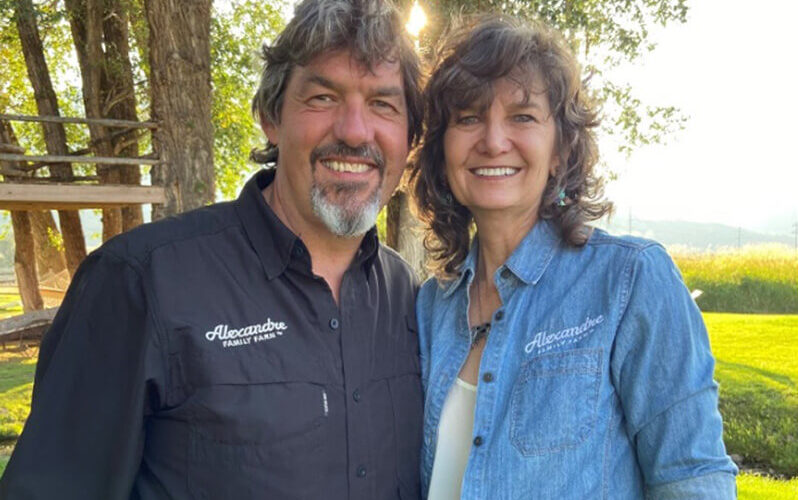
Stephanie and Blake Alexandre, regenerative dairy could be medicine

Stephanie and Blake Alexandre are the owners of the Alexandre Family Farm, the first regenerative dairy in the world. Fourth generation dairy farmers with over 40 years of experience, Blake and Stephanie Alexandre founded Alexandre Family Farm in Crescent City, California in 1988.