Alfonso Chico de Guzmán – The ag-tech that brings cows back
Alfonso Chico de Guzmán – Ag-tech done right, enabling farmers to bring cows back onto thousands of hectares where fencing is impossible
A new conversation with Jonathan Lundgren, one of the world’s most interesting and most cited scientists when it comes to regenerative agriculture. For the last four years, Jonathan and his team have been in full swing with their 1000 Farms Initiative, where they document research and follow regenerative farms, actually closer to 1600 farms now.
An episode where we talk about data, data, and more data. We unpack a four-year effort that spans commodities, ecoregions, and management styles, revealing how regeneration scales in the real world. The results are striking: equal or better yields, stronger profits, higher biodiversity, improved water infiltration, and a path to substantial soil carbon storage, all without needing more land.
But it isn’t just about that. It’s about farmers’ health and happiness. It’s about pushing our imagination of what farmland could look like. It’s about the outliers in these studies that show us what is possible: more people on the land, more farmers connected to every acre being managed. It’s about producing food for your family and community. It’s about revitalizing rural communities and bringing back the life that has been sucked out of there. Enjoy this wide-ranging conversation with Jonanhan (though, as always, it feels too short!).
A conversation with Maria Jensen, co-founder of Antler Bio, helping dairy farmers identify and address factors limiting their herd’s full potential. What if cows could speak? Especially dairy cows. They would probably share not only the horrors of the dairy industry, but also stories of many dairy farmers who truly try their best to care for their animals and yet still fail. Their cows are neither healthy nor happy, their bank accounts look worse every year, and their mental health and marriages are shaky. Intensive dairy, unless you are massive, is a very difficult industry.
Yes, all dairy cows (and cows in general) should be, depending on the context, almost permanently outside. And yes, calves should stay with their mothers as long as possible if we are even going to start talking about regenerative dairy. But for many dairy farmers, this is still a distant pipe dream. We need to meet them where they are. If we don’t give them concrete tools now, they will never change and instead go out of business. And no, dairy won’t disappear any time soon. The market will just be absorbed by even bigger dairy cow factories, where cows never see grass or sunlight.
So how do we change this gridlock? By taking technology from the racehorse industry to let cows and herds speak: to share what’s missing, what could be improved. And, surprise, there is plenty of low-hanging fruit in improving dairy cows’ lives practically overnight from better minerals to more water points, and of course the holy grail: super-diverse pasture management.
This leads to healthier cows, fewer vet costs, and more milk. Importantly, it also points toward potentially healthier milk, and thus healthier people. It’s still too early to connect this directly to nutrient density and quality, but that’s the direction we’re headed.
We also touch upon much more: the risks of raising money from the wrong parties for such a disruptive technology, the fact that while animals and farmers win, input companies and pharmaceutical companies will likely lose. Suddenly it becomes clear which interventions work and which don’t.
And what about raising finance as a female founder? Surprise surprise—it’s not easy. Male investors, especially, waste a lot of your time.
Get ready for a conversation about disruptive tech, dairy farming margins, raising capital, and horse racing.
Legend alarm on the podcast! We are happy to welcome the Haggerty’s family, Ian and Dianne, together with their son Matthew, on the podcast sharing their 30+ year journey- from being considered the hippie weirdos to leading a movement in Western Australia- showing that you can absolutely farm regeneratively at scale, in this case over 60,000 acres, with deep regeneration.
They regularly take on new land, but only if they feel the land wants and needs them to manage it. In other words, they don’t go looking for land, the land finds them. Often this land is extremely degraded, and they bring it back to life with the help of sheep, whose gut microbiome kickstarts regeneration, followed by well-integrated annuals.
We talk about how fundamental it is to allow anything that wants to grow to grow in a brittle environment. They don’t have the luxury of discussing the concept of weeds: anything that can stay green and alive, with living roots in the soil pumping out exudates during the brutal hot summer months, is welcome.
We also dive into the different water cycles they are influencing and how these have even affected local rainfall. Of course, we unpack the massive mindset shift that is fundamental in the regenerative transition, vibrations, quantum agriculture, and rebuilding local supply webs. We cover it all.
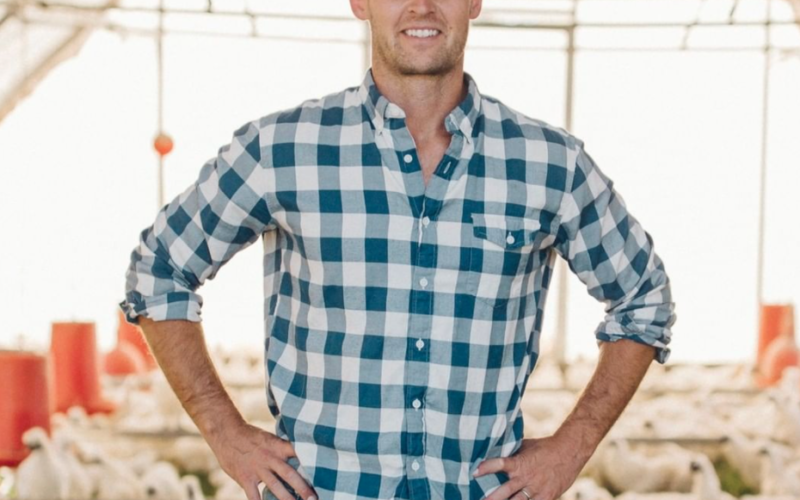
A barefoot conversation across his Danish farmland with Frederik Lean Hansen, advisor on regenerative farm finance, revealing the efficiency of his pasture-raised chicken operation and Abunda, the revolutionary business he’s building to connect land holders with entrepreneurial farmers.
How many times have you visited a farm or heard a story from a farmer or landowner who wished for more people on the farm? Someone to start a market garden, run a chicken operation, or build an advanced biofertiliser brewery? More stacked enterprises, more diversity, and more hands and eyes on the land- of course, only if it makes financial sense. But let’s assume that’s the case. Where do you find these entrepreneurial people who fit your context, your farm, country, culture, and personality? And once you find them, how do you structure the financial and legal side to create a partnership that lasts?
We probably all agree that we need more well-paid people on the land—so how do we make that happen?
This episode is a conversation where we walk the land (just a few hectares) and check in on the latest developments: pasture-based chickens on Fred’s farm, the earliest steps into agroforestry and, most importantly, Fred’s new venture focused on land matching. That is connecting landowners with those ready to work the land but lacking access, to facilitate lasting land partnerships.
It just doesn’t happen very often we record in a field surrounded by cows just after a cow gave birth to a calf. There is not more fitting place to explore the super complex role of animals in the food and agriculture space than walking the land- and standing amongst the cows- with Benedikt Boesel, founder and farmer at Gut&Bösel, in Alt Madlitz, in Germany.
Very few topics will divide people in and outside the food space quicker than cows. So we are walking that fine line literally surrounded by three hundred cows who are an integral part of the fertilisation of Benedikt’s 1000-hectare arable farm with very sandy soils. We discuss everything from how much joy animals bring to a farm and how complex it is to treat them well and how they are a direct mirror of your actions. We talk as well about the moment in which the cows are taken out of the system, and how Benedikt does that (we are sorry if the first part of the episodes shocks you, but this is also part of the food and agriculture sector to face and consider. Even if you don’t consume animal protein, your fields are going to be fertilised by either fossil fuel fertiliser or animal manure).
Ichsani Wheeler, co-founder of OpenGeoHub and Envirometrix, challenges dominant assumptions in land use and agricultural design, making the case for more large animals in our landscapes—not fewer. She explains why understanding the maximum ecological carrying capacity of agro-ecological systems is essential for restoring function, productivity, and resilience in both natural and farmed environments. Wheeler advocates for granular, place-based research to better inform ecological planning, arguing that broad generalizations fall short when it comes to the complex realities of nutrient cycling and biomass distribution. Megafauna plays a critical role in ecosystems as mobile nutrient cyclers, their absence leads often to stagnation and imbalance.
As we wrap up 2024, we reflect on a year that brought hope but also served as a wake-up call. With skyrocketing temperatures, droughts, fires, and floods, the challenges have been immense. But we were very lucky that we—both online and offline— had the chance to come together with many of the pioneers and builders in regenerative agriculture and food. At the same time, we were reminded that we, as part of nature, are at war with extractive forces.
Our takeaways on ambitious entrepreneurs, the many elephants in the room, role and legacy of farmers, innovation in water cycle restoration, money money money, building new industries. Many deep dives in soil health, starting with chefs, consumer brands driving change and educating consumers, walking the land with regenerative farmers, legends, role of AI and tools. And, finally, some milestones and highlights.
A conversation with Marco Carbonara, cofounder, owner and farmer at Pulicaro Farm, in Lazio, Italy. A special early morning walk through permanent pasture surrounded by multispecies graziers, donkeys, cows, sheep, goats, chickens and, of course, some guard dogs, which means a lot of pleasant and present background sounds. We are in the hills between Rome and Florence and have the great pleasure to visit the farm of Marco and Chiara. Marco takes us on the morning walk to feel, smell, and see regeneration of permanent pastures in a Mediterranean landscape. Definitely not easy, but definitely possible, and yes, also profitable.
How did Marco, who had no farming experience 20 years ago, approach regeneration back then, and how does he approach it now? When they take on new lands, what are the first steps, and how much has he learned over the last 20 years? What is the role of animals in regenerating the Mediterranean landscape, and how does he handle the challenging balance between running a company, needing to break even, and wanting to regenerate as quickly as possible?
We also discuss the challenge of feed: is it okay to bring feed for the non-ruminants in your rotation from outside the farm when your soils can’t yet sustain needy plants like wheat, barley, etc.? And if it is, how do you deal with the challenge of potentially competing for human food? We only scratched the surface because it’s impossible to capture 20years of deep regeneration in just one hour, but we tried and we hope you enjoyed listening to it as much as we did recording it.
A wide-ranging conversation with Frederik Lean Hansen, a regenerative farm business consultant who spent a year traveling and working on 12 farms alongside regenerative farmers across Europe. He is currently active as a Farm Finance genitor and is now starting his own silvopastured poultry enterprise on his parents’ farm in Denmark. We discuss topics such as finance, CapEx, OpEx, income statements, and cash flow, as well as the myth of small-scale farming and whether economies of scale truly matter. Fred shares insights on how farmers can organize together to access better markets, run more financially successful businesses, and improve their quality of life. We also delve into the importance of inner work, which is often neglected in our sector—or any sector, for that matter.