Tag: cows

Alfonso Chico de Guzmán – The ag-tech that brings cows back

Alfonso Chico de Guzmán – Ag-tech done right, enabling farmers to bring cows back onto thousands of hectares where fencing is impossible

Maria Jensen – Giving cows a voice through epigenetics while improving animal welfare and profitability

A conversation with Maria Jensen, co-founder of Antler Bio, helping dairy farmers identify and address factors limiting their herd’s full potential. What if cows could speak? Especially dairy cows. They would probably share not only the horrors of the dairy industry, but also stories of many dairy farmers who truly try their best to care for their animals and yet still fail. Their cows are neither healthy nor happy, their bank accounts look worse every year, and their mental health and marriages are shaky. Intensive dairy, unless you are massive, is a very difficult industry.

Yes, all dairy cows (and cows in general) should be, depending on the context, almost permanently outside. And yes, calves should stay with their mothers as long as possible if we are even going to start talking about regenerative dairy. But for many dairy farmers, this is still a distant pipe dream. We need to meet them where they are. If we don’t give them concrete tools now, they will never change and instead go out of business. And no, dairy won’t disappear any time soon. The market will just be absorbed by even bigger dairy cow factories, where cows never see grass or sunlight.

So how do we change this gridlock? By taking technology from the racehorse industry to let cows and herds speak: to share what’s missing, what could be improved. And, surprise, there is plenty of low-hanging fruit in improving dairy cows’ lives practically overnight from better minerals to more water points, and of course the holy grail: super-diverse pasture management.

This leads to healthier cows, fewer vet costs, and more milk. Importantly, it also points toward potentially healthier milk, and thus healthier people. It’s still too early to connect this directly to nutrient density and quality, but that’s the direction we’re headed.

We also touch upon much more: the risks of raising money from the wrong parties for such a disruptive technology, the fact that while animals and farmers win, input companies and pharmaceutical companies will likely lose. Suddenly it becomes clear which interventions work and which don’t.
And what about raising finance as a female founder? Surprise surprise—it’s not easy. Male investors, especially, waste a lot of your time.

Get ready for a conversation about disruptive tech, dairy farming margins, raising capital, and horse racing.

Walking the land with Benedikt Boesel – Fully integrating 300 cows into a 1000-hectare arable very sandy farm

It just doesn’t happen very often we record in a field surrounded by cows just after a cow gave birth to a calf. There is not more fitting place to explore the super complex role of animals in the food and agriculture space than walking the land- and standing amongst the cows- with Benedikt Boesel, founder and farmer at Gut&Bösel, in Alt Madlitz, in Germany.
Very few topics will divide people in and outside the food space quicker than cows. So we are walking that fine line literally surrounded by three hundred cows who are an integral part of the fertilisation of Benedikt’s 1000-hectare arable farm with very sandy soils. We discuss everything from how much joy animals bring to a farm and how complex it is to treat them well and how they are a direct mirror of your actions. We talk as well about the moment in which the cows are taken out of the system, and how Benedikt does that (we are sorry if the first part of the episodes shocks you, but this is also part of the food and agriculture sector to face and consider. Even if you don’t consume animal protein, your fields are going to be fertilised by either fossil fuel fertiliser or animal manure).

Marco Carbonara – Using 10 species of animals to profitably regenerate 100 hectares of forgotten Italian land between Rome and Florence

A conversation with Marco Carbonara, cofounder, owner and farmer at Pulicaro Farm, in Lazio, Italy. A special early morning walk through permanent pasture surrounded by multispecies graziers, donkeys, cows, sheep, goats, chickens and, of course, some guard dogs, which means a lot of pleasant and present background sounds. We are in the hills between Rome and Florence and have the great pleasure to visit the farm of Marco and Chiara. Marco takes us on the morning walk to feel, smell, and see regeneration of permanent pastures in a Mediterranean landscape. Definitely not easy, but definitely possible, and yes, also profitable.

How did Marco, who had no farming experience 20 years ago, approach regeneration back then, and how does he approach it now? When they take on new lands, what are the first steps, and how much has he learned over the last 20 years? What is the role of animals in regenerating the Mediterranean landscape, and how does he handle the challenging balance between running a company, needing to break even, and wanting to regenerate as quickly as possible?

We also discuss the challenge of feed: is it okay to bring feed for the non-ruminants in your rotation from outside the farm when your soils can’t yet sustain needy plants like wheat, barley, etc.? And if it is, how do you deal with the challenge of potentially competing for human food? We only scratched the surface because it’s impossible to capture 20years of deep regeneration in just one hour, but we tried and we hope you enjoyed listening to it as much as we did recording it.

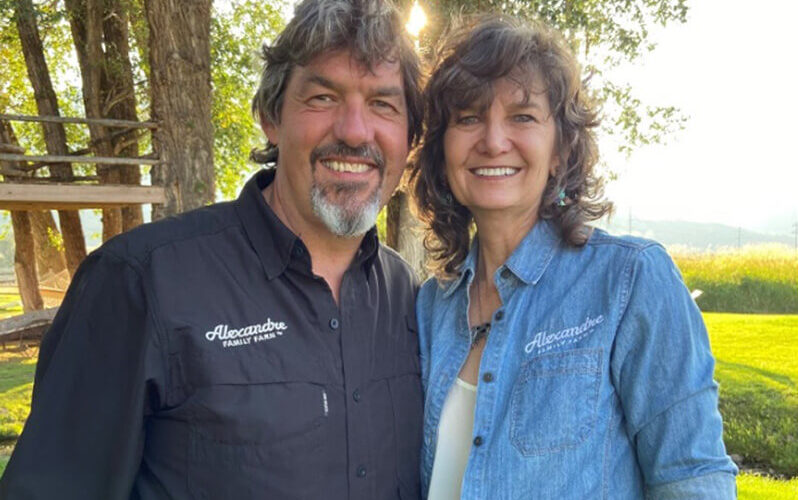
Stephanie and Blake Alexandre, regenerative dairy could be medicine

Stephanie and Blake Alexandre are the owners of the Alexandre Family Farm, the first regenerative dairy in the world. Fourth generation dairy farmers with over 40 years of experience, Blake and Stephanie Alexandre founded Alexandre Family Farm in Crescent City, California in 1988.