Tag: water

Lauren Tucker – Inner regen work, gut molds, almonds groves in the Central Valley and taste buds

This is a check-in conversation with Lauren Tucker, co-founder of Kiss the Ground and Renourish Studios. We talk about wrapping up the cohort at Renourish Studio, where they’ve worked for three years with a diverse group of entrepreneurs and investors across the US food and agriculture system.

How do you bring the fact that we are part of a living system into your work in commercial organisations? Lauren shares lessons learned, and what they’re doing moving forward. How much of this work is inner work—how we see the world, what we think is possible and not—vs. outer work like planting cover crops, digging swales, showing the financials and nutrient density of almonds, and demonstrating how regenerative farming systems are more alive by measuring biodiversity? How do we open up to opportunities like small water cycle restoration, instead of only thinking about cover crops on our farm?

Rob de Laet – Water is key to cool the planet within 20 years

A conversation with Rob de Laet, project lead of Cooling the Climate and co-author of the book Cooling the Climate: How to Revive the Biosphere and Cool the Earth Within 20 Years. The science is pretty clear and getting clearer by the day: water cools the planet. The more living, healthy vegetation we have on this planet, predominately perennials and thus trees, agroforestry systems and healthy forests, the cooler the climate is and the less extreme weather events occur. Living plants literally make the Earth sweat and remove heat from the biosphere.

Humans have systematically devegetated the planet as Judith D. Schwartz likes to say, and the ongoing climate weirding suggests we may have gone too far. Now we’re seeing real calculations: how many square kilometres do we need to regenerate to lower the global temperature by just one degree?
If this is all becoming increasingly evident, why isn’t it common knowledge yet, especially in the headquarters of banks, insurance companies, sovereign wealth funds, and governments?
This is the story of a successful entrepreneur getting drawn into water cycle restoration, planetary cooling and all the good stuff that comes with it. We share notes on why this movement, maybe the defining story of our time, hasn’t broken through yet and what we can do about it.

Matt Orlando – From Noma to building the world’s most circular restaurant and disrupting the chocolate industry

A conversation with Matt Orlando, chef, entrepreneur, and former head chef at Noma. He is also the founder of Amass, one of the most circular and fully organic restaurants in the world, which closed at the end of 2022. He then focused on a project in Singapore and is now back in Denmark, currently very busy with, among other things, a new restaurant in Copenhagen.

What happens when someone who worked as a head chef in one of the best restaurants in the world, Noma, starts going deep down the rabbit hole of sustainability and responsibility? Join the fascinating journey of one of the most interesting chefs in the world, who not only redefined what a circular, sustainable restaurant means (and no, it isn’t more expensive to run, and it doesn’t require a lot of tech, etc.) but it does require a completely new mindset and way of thinking.

He shares some fascinating examples and data, like monetary savings- €17,000 in a year on water costs, for instance- which were only possible because of a mindset shift. We talk about the role of fine dining and the hospitality world in transforming the agri-food system, the role of technology, and of course, fermentation, and the VC-funded BS in food tech and fermentation.

We discuss their new restaurant concept, still very much under wraps, but exciting. And also, how they are disrupting the very dirty cacao and chocolate industry with an upcycled, fully organic, price-neutral spent brewers’ grain, which you can already find in “chocolate” cookies in the Nordics without tasting the difference.

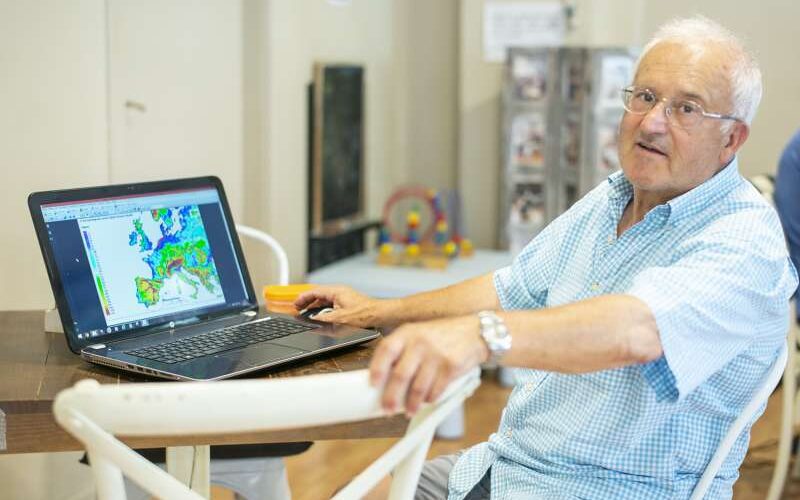
Ali Bin Shahid, one of the few who can model and calculate water cycle restoration

A conversation with Ali Bin Shahid, an engineer with a deep background in permaculture (and a military one too), a passion for modelling and one of the very few people using data and engineering approaches to tackle critical questions about regeneration. We explore how to put numbers to abstract ideas like slowing water down, spreading it, and soaking it. What does “slow” actually mean? How do we measure it—by kilometres per hour, or some other metric? How much regeneration is required to restore rivers or trigger rains in a given landscape? And, for example, where globally do we have the biggest potential? Where is the biggest gap between the forest and water potential and the current situation on the ground?

It’s definitely possible to manage a few acres or a few hectares through observation, if you’re there for many decades or even through different generations. But as soon as we start talking about regeneration at the landscape level, we need numbers. We need numbers and models. Surprisingly, a lot is already possible: we can calculate to a relatively detailed degree, what certain flows of air, water, and moisture will look like in a landscape. This means you can start to calculate and imagine, almost at a parcel level, where we need to regenerate in order to restore, for instance, summer rains and year-round rivers.

The surprising part is how few people are doing this work. Ali is trying to quantify these ideas: how much water to slow, where the global potential lies, and the vast gaps between current conditions and what’s achievable.

Jesús Areso Salinas – Building towers to trigger rain, to help nature sweat and cool

A conversation with Jesús Areso Salinas, retired from work as patent examiner at the European Patent Office and now active with his project to fight climate change combining water, katabatic tower and moisture. Another record-breaking summer in the global north, where temperature records were shattered repeatedly, prompts us to ask: is there a sustainable future for places like the Mediterranean? Jesús wondered how does nature cool? and, crucially, could we help nature kickstart the cooling of ambient air?”

Imagine cooling our surroundings during a heatwave—cooling town squares, vegetable gardens, or farms on a small scale. What if, over time, this approach spreads, with more people cooling their surroundings, allowing plants and trees to continue growing through the summer and helping to cool the air? Could this restoration of local cooling contribute to rebalancing water cycles, bringing back summer rains, and even creating a lasting cooling effect? These are big, almost magical questions, and they are exactly why we tackle them here with Jesús, an engineer turned permaculture expert, who is now building towers to help nature “sweat” and cool.

Sure, we could retreat to air-conditioned spaces, but air conditioners only worsen the problem by using energy to move heat from inside to outside without solving anything at its core. And what about plants, trees, and animals? They need a humid, comfortable environment to thrive, yet during hot, dry summers, they’re focused on survival rather than growth—or the cooling process essential to their function. Mediterranean farmers, in particular, take note: during the peak of summer, your plants and trees often stop growing because it’s too hot and dry.

So, how does nature cool itself? Through transpiration, plants and trees release moisture, which cools the surrounding air. However, as heatwaves become stronger, it’s often too hot for them to function, meaning they can neither grow nor cool the air. This lack of cooling is a problem farmers and investors need to understand—especially those in warmer climates, where plants and trees may be unable to photosynthesize or grow for weeks. Cooling ambient air is essential, and air conditioning isn’t the answer.

Yanik Nyberg – Are saltwater plants grown on tens of millions ha of abandoned, drained salt marshes going to be the livestock feed of the future?

A conversation with Yanik Nyberg, co-founder of Nara Climate and Sea Water Solutions, about feed for aquaculture and on-land livestock, salinity—when soils get saltier. Millions of hectares of former soil marshes close to the coast have been drained over the last thousands of years and often farmed, slowly but surely because of rising seawater levels. Soil water is creeping back in, and traditional farming is getting impossible. What do we do with these millions of hectares? One way is to rewet them and grow salt-loving plants called halophytes. These plants are also great feedstock for the aquaculture industry and poultry to replace the massive negative impact of soy.

So, what is holding back the large feed companies from incorporating this novel but originally the feedstock of many fish into their mixes? Interestingly enough, most of the world’s deserts are getting saltier too. Because of extreme rain, yes, it rains in the desert every now and then, which leads to flash floods. Millions of livestock pastoralists and their animals are suffering because of drought and floods, and the salts make their grass-based pastures disappear. Could the magical salt-loving halyphoates also be grown in the desert and feed these animals?

Felipe Pasini – Walking the land of Amadeco Syntropic Farm with a regenerative farmer

What if you could turn a dry, water-scarce plot of land into a thriving ecosystem? In this new episode of Walking the Land with a Regenerative Farmer we follow the journey of Felipe Pasini, as we explore his transformative work on the Amadeco Syntropic farm in Depressa, Salento, Puglia. Felipe reveals how he tackled the challenges of traditional dry stone walls, rocky soil, and limited water supply to create a productive, visually stunning farm organized into innovative elements.

Fernando Russo – From selling Playboy’s to growing coffee, cacao, credit and lots of cows

A deep dive conversation with Fernando Russo about the reasons why he is going deep into coffee and cacao without being a coffee drinker and how he turned from being a Playboy’s salesman and a travel entrepreneur to an impact investor in the regenerative agriculture and food. We also talk about fashion and heights, the Amazon, deforestation, reforestation, the role of cattle—the good, the bad, and the ugly—and, of course, the potential and why he is in the water camp, not the carbon camp.

What is driving one of the most active impacts investors in the regenerative space? What Fernando tells fellow impact investors when they ask him about this regen thing?
Getting credit and other finance into the hands of farmers and land stewards who want and can change is way more important. Let’s get to work.

Matteo Mazzola – Walking the land of Iside Farm with a regenerative farmer

This is a special episode, the first one ever of the Walking the Land with a Regenerative Farmer, where we walk the land of the farm with a farmer while we talk about regeneration. 

Walking through Iside Farm on the Iseo Lake in Italy, with regenerative farmer Matteo Mazzola, we unlock the secrets of regenerative agriculture as we traverse the innovative landscapes crafted by Matteo, Paola and the Iside crew. We embark on a profound exploration of sustainable farming, showcasing Matteo’s expertise in farm design, water systems, and the integration of olive trees and animals into the land. Learn how access ways are more than just paths across a farm; they’re a vital component in the flow of energy and resources, helping to prevent erosion with concrete strips and alfalfa, and offering additional crop space. Matteo’s wisdom extends to the creative reuse of shipping containers, illustrating a commitment to terraforming that marries functionality with environmental stewardship.
Our Vital Role as Keystone Species in restoring Water Cycles

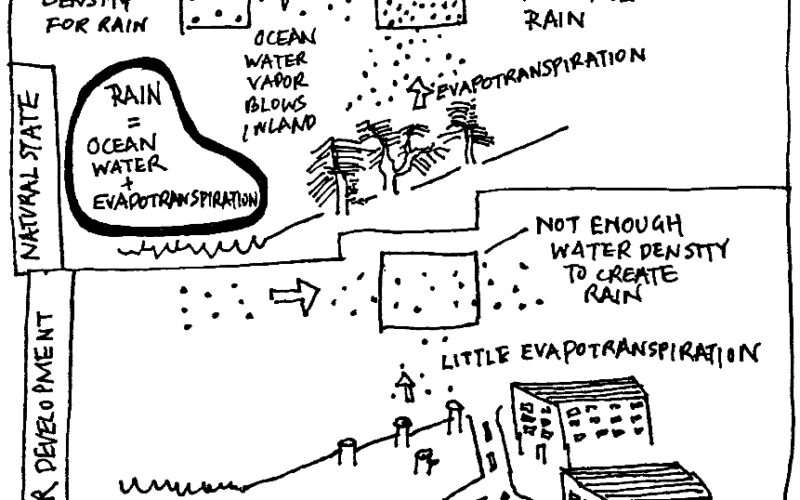
The disparity in attention between water vapour, constituting 60–70% of the greenhouse effect, and CO2 at 25%, prompts a crucial question: why is water vapour seldom discussed in climate discourse? Perhaps because addressing its role requires extensive global reforestation and regeneration efforts across the planet.

Do we even have the imagination needed to restore marshes, mangroves, and perennial pastures with trees, and strategically reforest and revitalise ecosystems?

This approach- the intentional large-scale intervention in the Earth’s climate system to counter climate change, called climate engineering- highlights humanity’s urgent role in environmental conservation and restoration. The call to action is clear.