Category: Soil Builders

Dimitri Tsitos – The massive opportunity of regenerative practices in intensive tree crops and why data is the only thing that will unlock it

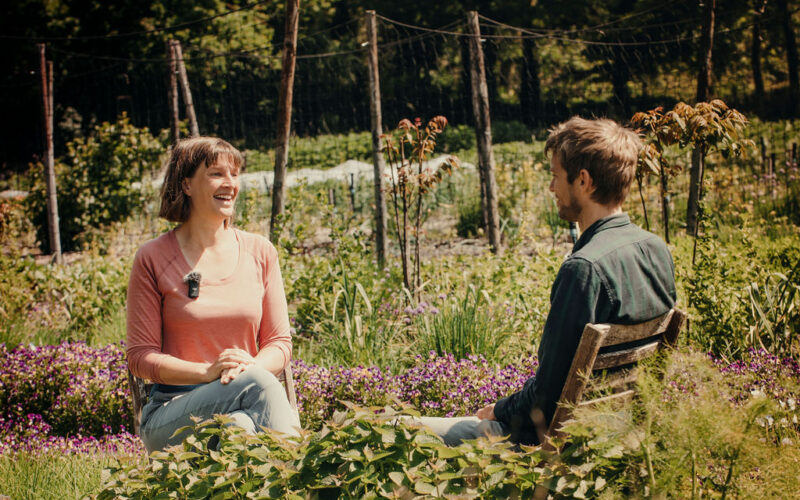
This is a check-in conversation, an update on what three years of stacked regenerative practices on a real commercial almond plot is beginning to show with Dimitri Tsitos, co-founder of Agrosystemic and leading the Arbo-Innova project with real data now starting to come in.

Regenerative practices clearly work in these systems. But which ones? In what order? And how many at the same time before you’re doing more harm than good?

Take the clovers growing in the tree lines — what Dimitri calls living mulch. They fix nitrogen and push more of it into the tree than conventional fertilisation does. But in the first years, they also compete with the young trees for water, leading to slower early growth. Is that trade-off worth it? Do the trees catch up?

What the first data is already showing: Herbicide applications halved in a single season. Nitrogen levels inside trees on clover-berm plots higher than in conventional neighbours. Fungal disease pressure significantly lower on the organic test plot — with three bacterial spray rounds versus the neighbours’ ten synthetic ones. And an industry that, until recently, was watching from a distance, now leaning in.

None of this is easy. The J-curve of transition is real. The compromises — between tree establishment and soil cover, between water competition and nitrogen gain — are real. But the first data is clear: regenerative practices offer massive opportunities to reduce the environmental impact of intensive orchard systems in a profitable way. More resilient industry. Huge environmental wins. A transition that pays.

Silke German – Creating the Tesla of beans by saving the milpa regenerative growing system

Mexico has thousands of bean varieties. Most people living in cities know four to five. Silke Gérman is on a mission to change that. She is the founder of La Comandanta, a premium heirloom bean and salsa brand now in its twelfth year of connecting smallholder milpa farmers in central Mexico to retail shelves in Mexico City, the US, the UK, and Germany.

Ancient Mexican bean varieties — grown for millennia in the traditional milpa polyculture system alongside corn and squash — are disappearing from fields and plates at the same time. Silke’s answer is neither a seed bank nor a subsidy. It’s packaging, storytelling, and making a purple runner bean from Puebla feel like something worth paying for. Along the way, La Comandanta has brought income back to communities that were emptying out, kept ancestral seeds in living soil rather than frozen storage, and built a value chain that pays farmers fairly — one bag of heirloom beans at a time.

What we learned in 2025 about making regen bankable, animals, water, chefs, scale, Al in ag, agroforestry, education, food as medicine, ROl, storytelling

If 2025 had a soundtrack, it would be the sound of stress: stress in the system, stress in humans, stress in animals and in all other non human beings.

And then the cycle of Heat. Drought. Fire. Flood. Over and over again.
And yet, between the headlines, something else seems happening. We spent the year in conversation—with farmers walking their fields, scientists questioning old assumptions, investors rethinking risk, and builders experimenting in the real world. Online and offline, we found ourselves in rooms where regeneration wasn’t an abstract ideal, but really happening.

As 2025 comes to a close, it’s hard not to feel cautiously optimistic. The signals are there. Regeneration works and the direction is becoming clearer.

Toby Parkes – Mapping the underground fungi world by building a unicorn

In order to save and more importantly restore biodiversity we don’t need biodiversity or carbon credits; we need biologists to find super profitable business models within the magical deeply complex world of nature. It’s the case of Toby Parkes, founder and CEO of Rhizocore, with whom go deep into the third, mostly ignored, and much more complex kingdom: fungi.

Farmers’ Philosophy series! Koen van Seijen in conversation with Anne van Leeuwen, regenerative farmer and co-owner of Bodemzicht Farm

We can learn so much more from farmers than how to restore soil. Regeneration goes much further and deeper. In the second episode of the Farmers’ Philosophy series Koen van Seijen, host of the Investing in Regenerative Agriculture and Food podcast, talks with Anne van Leeuwen, regenerative farmer and co-owner of Bodemzicht Farm. A deep dive into the non-existence of nature-culture divide, getting back in touch with yourself, nutrient dense food as basic human right, community, minimum wage, true cost economy, and much more.

Soil Builders, saving harvests with small holders farmers and connecting local farms to city folk in the UK

In this episode we hear from Wolfgang Mittmann, founder and CEO of Savings Grains, how they are helping smallholder farmers save their harvests, fulfil their potential, and make sure that no good food goes to waste. Also Pete Russell shares more about his company, Ooooby, a social enterprise that connects local farmers to city folk through an organic fruit and veg box subscription service.

Soil Builders, regenerative agroforestry on Hawaii and soil carbon credits in Australia

What regenerative agriculture looks like with bread fruit in Hawaii and Bert Glover of Impact Ag Partners shares their part in the soil carbon credit deal with Microsoft and an Australian rancher.

Soil Builders, for robots not all weeds are created egual

A check in with Brent Kessel, investor in the New African Farmers bond, plus a deep dive with Ben Scott Robbinson of the Small Robot Company into the role of small robots in regenerative agriculture and why not all weeds are created equal.

Soil Builders, 40M for carbon farming in AU and transitioning a 1000a farm using regenerative approaches

A check in interview with Lachy Ritchie, co founder of Agtalent and Carbon Farming Foundation plus an update with Tyler and Tim Nuss of The Modern Acre.